Bookworm: February 2026
'The God of the Woods,' 'The Color of a Lie,' 'The Love Hypothesis,' 'The Escapes of David George,' 'Night of Many Dreams,' 'Miral'
This post contains an affiliate link or links. If you use a link to buy a book, I may earn a small commission. You can find all the books that have been featured in this newsletter in my Bookshop store.
For a short month, February has been eventful this year. The 17th stood out in particular, with people celebrating Mardi Gras, Lunar New Year and the start of Ramadan within the same 24 hours. Then there were Black History Month, Valentine’s Day and the Winter Olympics. I aligned my reading with most of these events, which means you get an extra title in this month’s Bookworm.
Table of contents
Fiction: “The God of the Woods,” by Liz Moore
Historical fiction: “The Color of a Lie,” by Kim Johnson
Romance: “The Love Hypothesis,” by Ali Hazelwood
History: “The Escapes of David George,” by Gregory E. O’Malley
Historical fiction: “Night of Many Dreams,” by Gail Tsukiyama
Historical fiction: “Miral,” by Rula Jebreal
“The God of the Woods”
Back in December, my local library system posted lists of its most-borrowed titles of 2025 in various formats. The lists I was most interested in:
Digital checkouts: “Solito” by Javier Zamora, “Braiding Sweetgrass” by Robin Wall Kimmerer, “Onyx Storm” by Rebecca Yarros
Physical books: “James” by Percival Everett, “Tilt” by Emma Pattee, “The God of the Woods” by Liz Moore
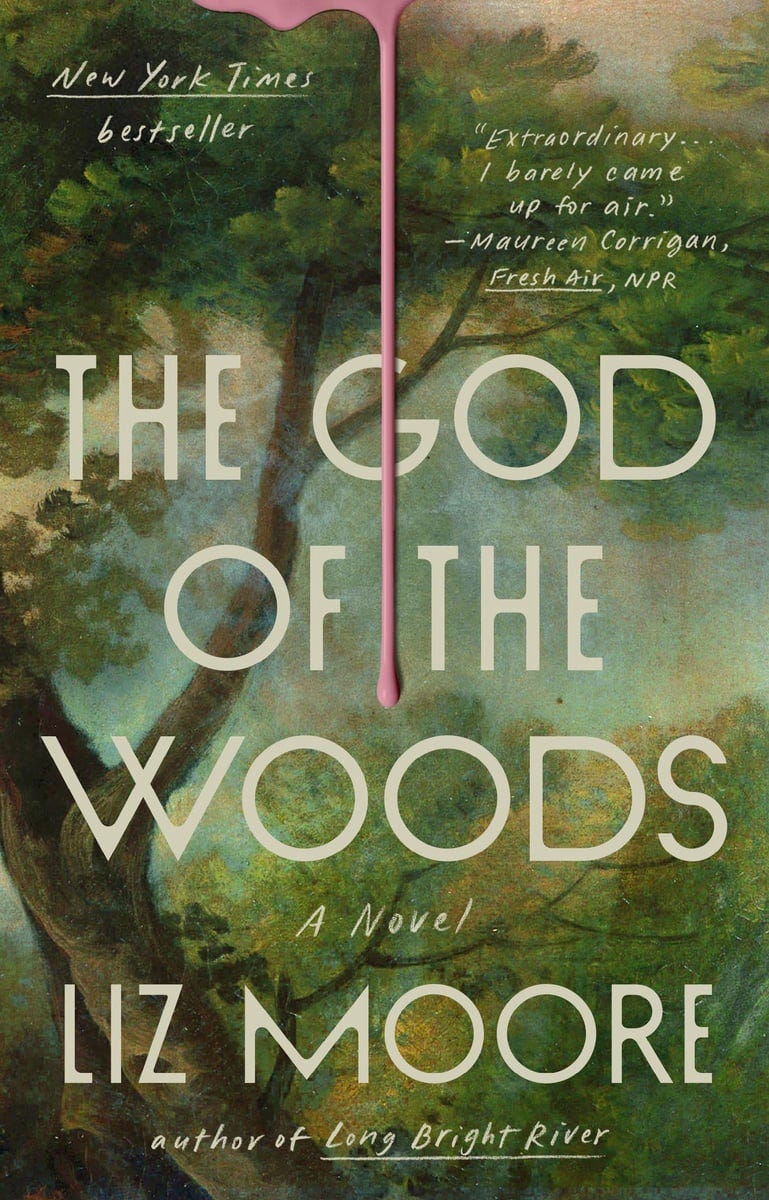
Having finished five of the six titles, I had to complete the set. “The God of Woods” went into my library hold queue and showed up a month later. It was worth the wait. I liked Moore’s “Long Bright River,” so was predisposed to enjoy “God of the Woods.” But I wasn’t prepared for how much.
The book had me turning pages way too late into the night. Call it a whodunit-meets-thriller-meets-family saga-meets community history. The action revolves around the wealthy, arrogant Van Laar family and is set on their country estate in New York’s Adirondack Mountains. There they run a summer camp for the children of their friends and others in their circle.
From this estate, the Van Laars’ precious and popular son, named Peter Van Laar IV but known to all as Bear, vanished years ago, when he was just 9. Now their teenage daughter, Barbara — whispered about as a “replacement” for her brother and far less beloved — has gone missing as well, from her cabin at the summer camp.
Moore juxtaposes the search for the boy with the hunt for the girl, hinting at overlapping factors in their disappearances. She also contrasts the privileged lives of the Van Laars with the surrounding community that depends on them for employment and other favors. Tension, suspicion, misdirection, secrets and lies are the norm in this world, making for a juicy, satisfying escape read.
“The Color of a Lie”
For Black History Month this year, my reading included a young adult novel set in what seemed like an unlikely place: Levittown, Pennsylvania.
I grew up hearing about Levittown as the first mass-produced suburb and, more potently, the embodiment of the American dream in the 1950s. What the marketing campaigns and press coverage glossed over was that Levittown was also built as a white-only community.
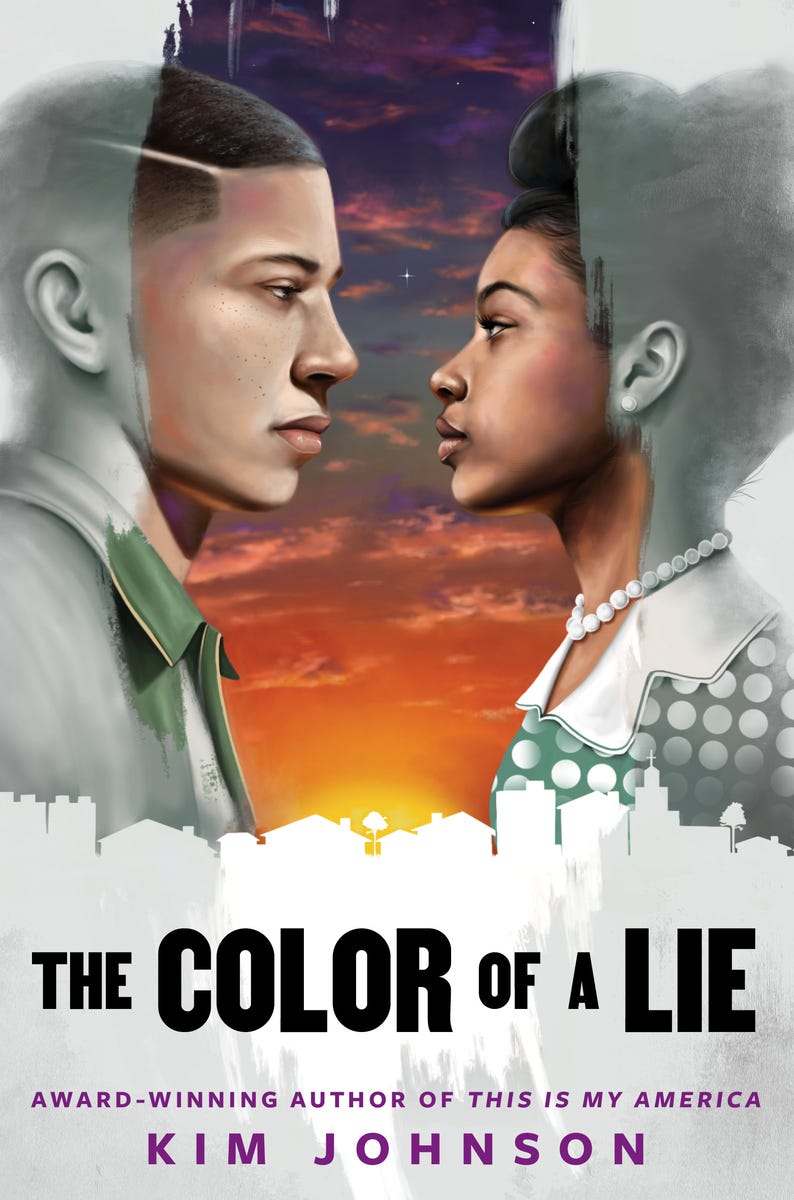
Kim Johnson explores this checkered past in “The Color of a Lie,” set in the fall of 1955: a year after the U.S. Supreme Court’s Brown v. Board of Education ruling that school segregation is unconstitutional, and shortly after the racist murder of Emmett Till. Teenage Calvin has just moved to Levittown with his parents, who tell him that he’s to take advantage of his light skin and pass as white at school. His parents also are passing; his father has even told his mother to stop calling herself Agnes and go by Ann to blend in better.
Calvin dutifully goes along with the charade, knowing his parents have the best intentions. But he’s grieving a recent family tragedy, distressed at having to leave his best friend with no explanation, and uncomfortable with having to hide who he is. Then Lily enters his life. She’s a Black girl from just outside Levittown who, taking the Brown v. Board ruling at face value, has transferred from the impoverished Black high school to the shiny-new white high school. To some people’s dismay, it turns out Lily’s neighborhood is within the Levittown high school’s attendance boundaries.
Soon Calvin finds himself juggling multiple secrets: His friendship with Lily. His visits to his older brother, estranged from their parents. His discovery of sinister threads in the civic fabric of Levittown. The pressure is building, and something will have to give.
“The Love Hypothesis”
What’s Valentine’s Day without a romantic read? This year, I got lucky: A friend offered a copy of Ali Hazelwood’s debut novel, “The Love Hypothesis.” I vaguely recalled hearing Hazelwood’s name somewhere, and I liked the back cover blurb describing the protagonist as a Ph.D. student in biology, a career path I once considered pursuing.
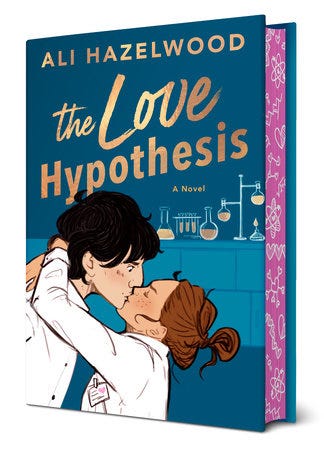
Well, consider me a new member of the Ali Hazelwood fan club. This romance is smart and funny, which gives it much of its sexiness. (Don’t worry, there’s actual sex, too.) Our protagonist, Olive Smith, is living her dream as a Stanford scientist. Even better, after years of loneliness (cue tragic backstory), she’s got a best friend, a fellow grad student named Anh.
Here’s where the fun starts: Anh has a requited crush on Olive’s ex but refuses to act on it, out of loyalty to Olive. So Olive tells Anh she’s going on a date. When Anh spots her in the lab instead, Olive panics and kisses a man who happens to be walking by. Who happens to be a faculty member, Dr. Adam Carlsen. Fortunately, he’s young, hot and single. Unfortunately, he’s notorious for making his grad students cry. Olive gets up the gumption to ask him anyway if they can fake-date for a while, because she’ll do anything for Anh, and to her astonishment, Dr. Carlsen agrees.
We all know how this ends. Getting there is why we read. Hazelwood puts her sham lovers into one inspired awkward situation after another, piles up the misunderstandings and misassumptions, and pens some truly hilarious dialogue. At the same time, the neuroscientist-turned-author sends Olive on a professional quest that highlights the roadblocks women still regularly encounter in the sciences.
Hypothesis: I will love this book. Proven!
“The Escapes of David George”
Upon reading about UC Santa Cruz historian Gregory E. O’Malley’s new book, “The Escapes of David George,” in The Washington Post’s “6 noteworthy books for February,” I promptly ordered it. I had been looking for my next American Revolution book and was hoping to find one from a Black perspective, for Black History Month. I was not surprised when the Post delivered.
The same day I went to pick up the book at my local bookstore, the Post laid off more than 40% of its newsroom staff, including the entire Books staff. The state of books coverage in this country is a whole separate post unto itself, for which I lack the enthusiasm; suffice it to say that we readers have lost, and bigly. Thanks to the Post’s Books staff for all they did, and I wish them all the best for their next chapters.
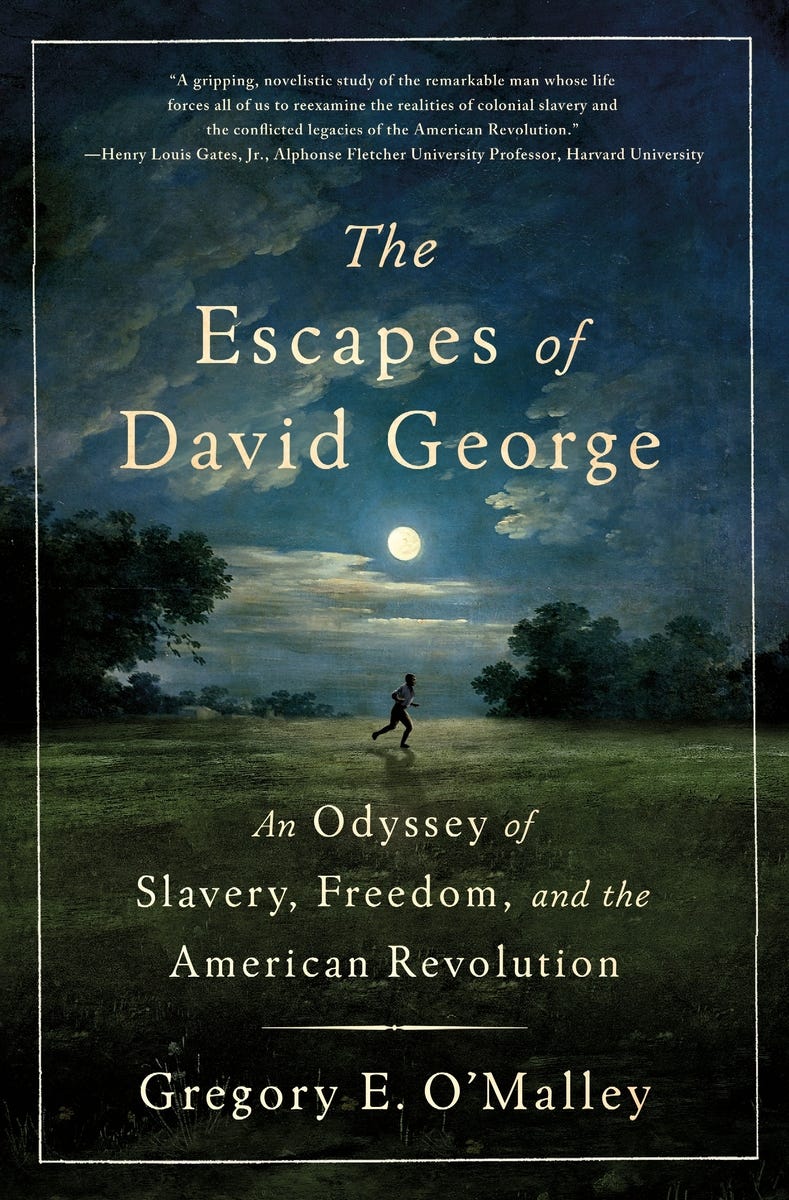
Back to Mr. George. His story is the earliest known firsthand account of a fugitive from slavery in North America, O’Malley writes. George gave this account to a group of London ministers in a 10-page account published in The Baptist Annual Register in 1793. That spare outline is more than the sum of its words, O’Malley argues:
In his struggle for freedom in early America, and ultimately his flight from the United States, David George can help all modern Americans see our society and the legacies of the revolution we inherit, warts and all.
How did George come to be in London? That was one stop in an epic journey that O’Malley has painstakingly documented:
Born on a Virginia tobacco plantation, running south to seek escape, taken captive by an Indigenous society recognized as an autonomous “nation” by colonists, working in the fur trade, and seeking freedom in a war-torn North America during the Revolution, David George offers a rare window on this earlier world.
O’Malley also posits that George deserves to be recognized as an American founding father. After a spiritual awakening, he began preaching and soon had a congregation — arguably the United States’ first Black Baptist church, his biographer writes.
Black churches are American bedrock. Their centuries-old call for America to live up to its stated ideals has done as much to make the United States democratic as Congress. If the founding fathers were the people who built America’s key democratic institutions, David George was one of them.
“Night of Many Dreams”
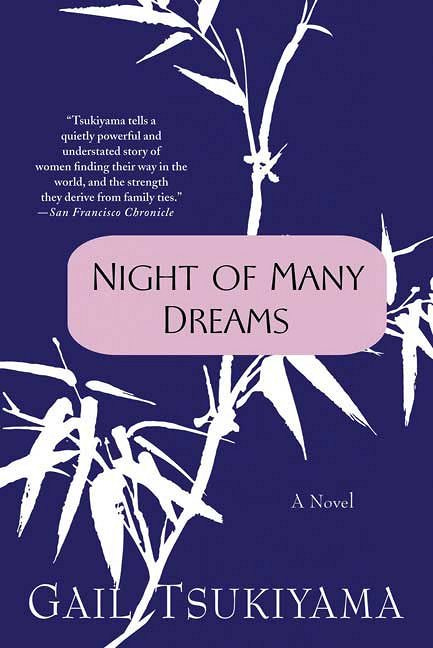
For Lunar New Year (welcome to the Year of the Fire Horse!) I dug into my "To Be Read” pile and pulled out Gail Tsukiyama’s novel about two sisters growing up in Hong Kong and Macao before, during and after World War II.
The Lew sisters have spent their early years in relative luxury. Joan, the older sister and “the pretty one,” pores over film fan magazines and dreams of becoming an actress. Emma is “the smart one,” a budding artist who dreams of travel. Their father is often away in Japan on business and their mother whiles away her days with lunches and shopping, so they’re being raised mostly by their parents’ longtime cook and housekeeper and their aunt, a single woman who runs a knitting factory.
Then the war descends on Hong Kong. The family endures trial after tribulation and finally flees to the relative calm of Macao. There, the first of several family secrets spills out.
Tsukiyama follows the sisters into early adulthood, as their paths diverge: Joan gets her movie stardom, but at a personal cost. Emma goes to the United States for college, falls in love and starts a family — but she, too, suffers. The book ends with her return to Hong Kong, bringing the sisters back together after many years.
While I didn’t take away any deep or new insights from “Night of Many Dreams,” I enjoyed it as a slice-of-life novel about a new-to-me region and history. Tsukiyama draws her characters well, and it was a pleasure to read a book centering a range of women’s stories.
“Miral”
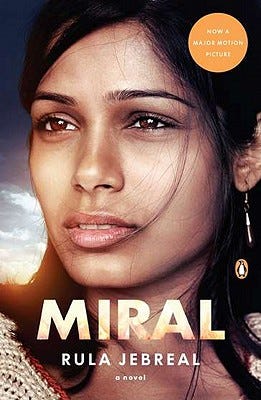
The novel “Miral” begins with a multitude mourning the death of Hind al-Husseini, a Palestinian woman whose career as an educator and activist began in 1948 when she found 55 children huddled together on a Jerusalem street. The adults in their village outside the city had been massacred; the children, dumped.
After rescuing those children, al-Husseini went on to open a school, mostly for girls whose parents had died or couldn’t raise them. The title character is one of those girls, based on author Rula Jebreal, who describes herself on her Substack as a foreign policy analyst, novelist, screenwriter, and an expert on the rise of fascism in Europe. She and her sister went to live at al-Husseini’s school, Dar el-Tifel, after their mother’s death, when Jebreal was 5.
“Miral” weaves together the lives of al-Husseini, Miral and other Palestinian women for a nuanced but unflinching look at the complexity of life along the Israeli-Palestinian border. 1948 is, of course, not just the year al-Husseini found 55 children but also the year the state of Israel was established on what had been a British-administered territory called Mandatory Palestine. By the time we get to Miral’s story in the late 1970s and early 1980s, war and killing have become daily facts of life. Miral is eager to join the Palestinian cause, but al-Husseini warns her that doing so could threaten her future.
I appreciate books that are mirrors and books that are windows: mirrors that reflect my perspectives and experiences, and windows that open onto other perspectives and experiences. “Miral” was a window I didn’t know I needed.
Enjoying Bookworm? Feel free to tip me (tips go to my PayPal).
Happy reading!
I like this: "I appreciate books that are mirrors and books that are windows: mirrors that reflect my perspectives and experiences, and windows that open onto other perspectives and experiences.” Thanks for another great read about great readsl
Agree with you about God of the Woods. And the closing of the Washington Post’s Bookworld ☹️